|
|
|
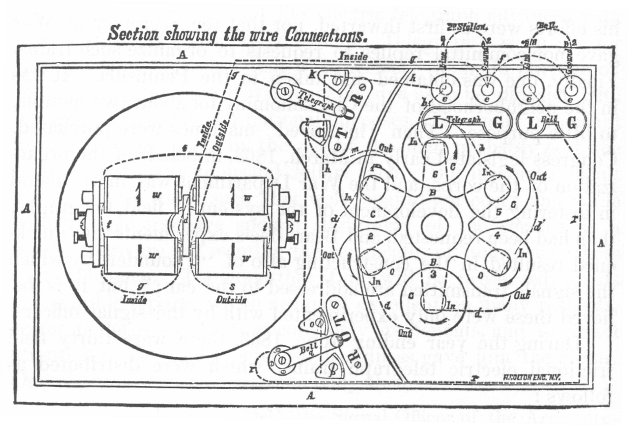
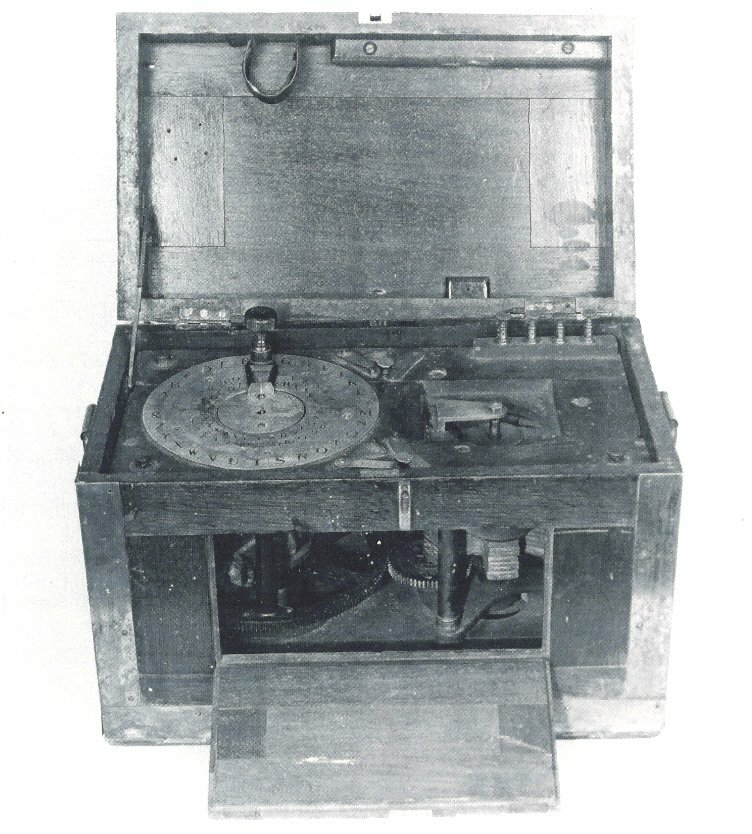
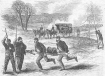
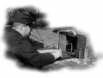
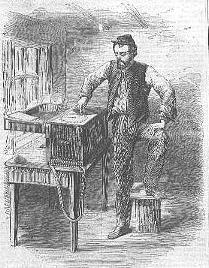
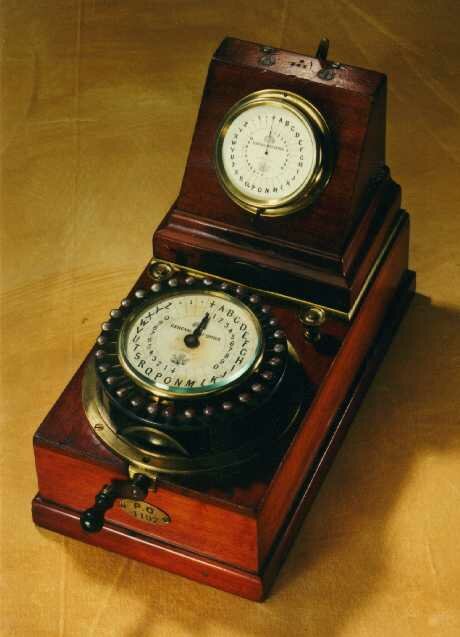
Sketch and Photo of the Beardslee machine
Beardslee Reproduction Project
 |
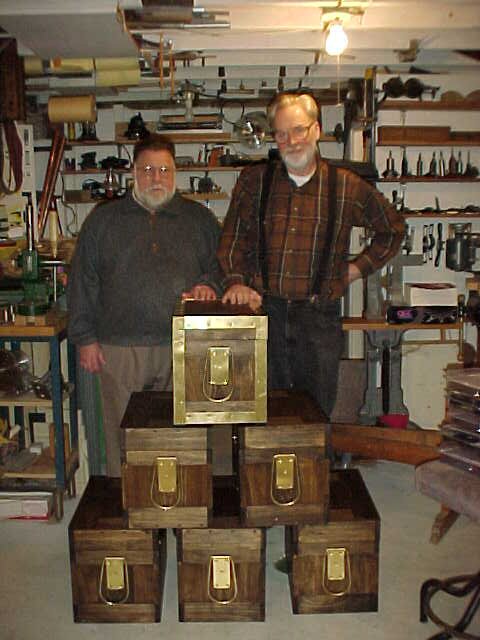 |
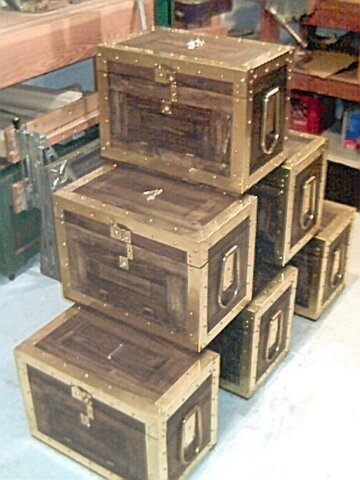
| Beardslee Boxes | Dave and Dave in front of the Beardslee sets |
 |
|
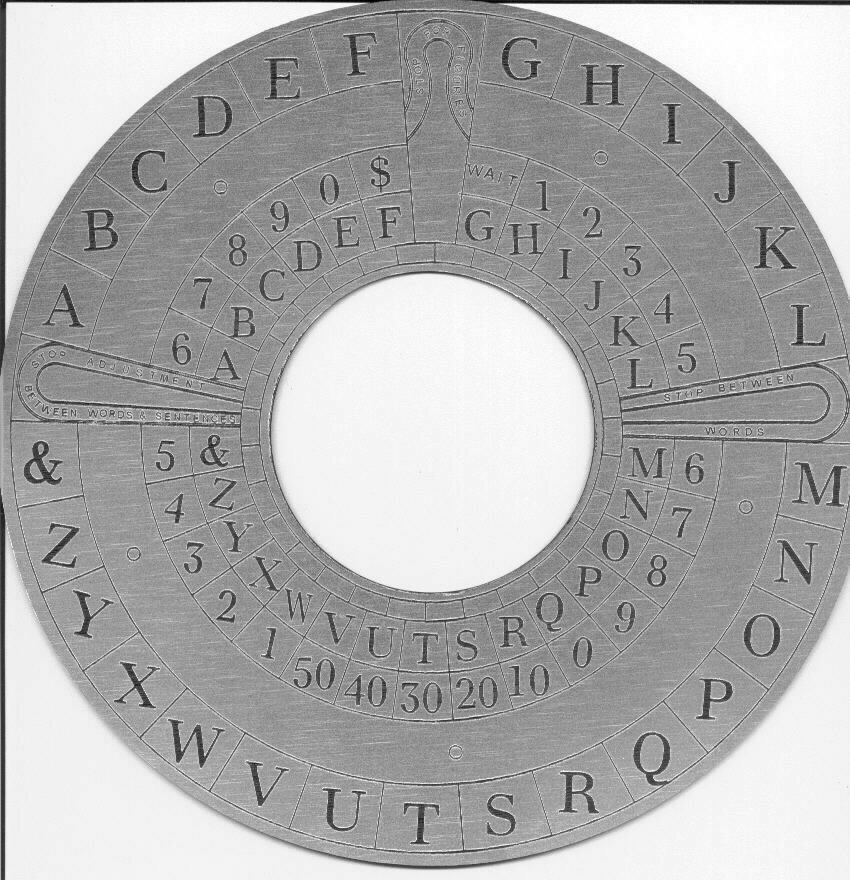
| Beardslee Dial This is the dial that Dave Harbin and Dave Bock have been working on. WARNING the image this links to is LARGE. |
Dave Harbin and Dave Bock have constructed six Beardslee telegraph machines from scratch. Dave Harbin constructed the boxes and mechanical pieces; Dave Bock did the dial construction and internal electrical design and final assembly. Although the Beardslee wasn't a huge success, it was part of the Signal Corps history during the Civil War and it was used. Recreating these pieces from scratch enables us to promote the entire history of the Signal Corps, not just the high points.
Click here for semi-technical discussion of the Beardslee.
NEW ADDITIONS:
1) Direct from Fort Gordon. Donated replica Beardslee sets 3 & 4 by Dave Harbin (2nd Michigan Infantry Signal and Telegraph Detachment) and Dave Bock (OVCWA and 19th US Infantry) and PHOTOS of the Hilton Head original. Also, a large 19 megabyte .pdf file from the Army Communicator history of the Flying Telegraph with some minor errors in the history in particular with regard to the last ten months of service. Strongly shows the impact of the USMT historical re-write even to almost the present day. The photo of the Beardslee is from the Smithsonian. (December, 2003 update of April,2002 entry)
2) Video in Real Media format (4.5 meg file) from the spring 2002 drill HERE We used two-way radios for feedback during this training session. Operators are sending and receiving the Beardslee manual. The ground returns are bayonets. The wire link (for this test only) is surplus WD-1 wire. Both pair of wires are in parallel. The ground was quite damp. Note the speed of the transmissions. These are actually a bit fast for the mechanics. (May, 2002--updated December, 2003)
3) You will also want to visit the discussion on the wire used by the Signal Telegraph system and later the USMT (post November 1863). (June, 2002)
4) The field manual for the replica Beardslee sets can be found HERE. (June, 2002)
5) The video of the syncronization process for Beardslee Telegraph sets on line as done at Bardstown, Kentucky the second weekend of June, 2002 CAN BE FOUND HERE. BIG 12 MEG FILE. Copper clad rods for ground. Captain David Schrodi is the operator. Lieutenant Jim Lady is on the other Beardslee. (June, 2002--updated December, 2003)
6) The mystery of the dial telegraph used by Myer in the Pennisula Campaign of 1862 has been what instrument did Rogers really use. HERE is the patent and a drawing for just that machine. The Chester Telegraph as noted in the forward of Plum's book (reprint by Ayer) by Paul J. Scheips. Note the similarities between the Beardslee telegraph and the Chester telegraph. The Chester machine used batteries. (December,2003)
7) The removal of the Beardslee telegraph from the Signal Corps as ordered by the Secretary of War in late November, 1863 was not without comment. Here are some of the comments supporting the Beardslee and the Signal Corps Field Telegraph. (July, 2002)
8) Historic first at Crossroads Village, Flint, Michigan: Four Beardslees in the field. Ed Corley's photographs captured the moment. (July, 2002)
9) The Beardslee's role at the battle of Chickamauga. (July, 2002)
10) The Beardslee's role just after the battle of Stones River. (July, 2002)
(11) The Beardslee magneto went on after the war to become the basis for the well known ignition devices for setting off explosive charges. Mention of this is here in this 1863 document. (Jan 2003)
12) The period of time of use for the Beardslee according to the USMT:"From about June, 1862, a field telegraph had been worked in the Army of the Potomac under the supervision of the Signal Corps, the wire used being of steel (six strands), covered with rubber, and the instrument the Beardslee magneto-electric machine. This instrument was found to be inefficient for speedy communication and failed to accomplish the result desired. In March, 1864, by an order of the Secretary of War, these field telegraph lines and instruments were turned over to me to be worked. I gave them a thorough trial. The instruments proved to be of very little practical use, and were sent to the rear, by order of Major-General Meade, previous to the movement of the army.". Note claimed is the use of the steel wire whereas other accounts make it pure copper. (May 2003)
13) So the dial telegraph was no longer used. Well, not true it turns out. See this OR from the United States Military Telegraph clearly establishing the use what is "most" likely the Beardslee around San Francisco harbor with undersea cables. One can assume that a larger gauge of wire allowed the dial telegraph to work well. Folks, this is the USMT! NOTE THE DECEMBER 1864 DATE. It is also possible that this was the Chester Dial Telegraph set which was, according to Plum, in wide use even after the war.(May 2003--Updated December, 2003)
14)Major Myer did not give up without a fight. The available Beardslee telegraph sets were gathered to him in New Orleans in May of 1864 where they were put to service. This order shows this gathering of the sets Major Myer could get his hands on. This OR dated August 10, 1864 shows the Beardslee sets very much in use in the defense of Mobile Bay. Note that Major Myer uses his title as Signal Officer of the Army even though he has been "removed" and banished. He refused to resign his commission. Lacking a Courts Martial, the Secretary of War's order could not be fully enforced. So, the Beardslee went on to be used for the rest of the war in the West as well as the above mentioned use in the far west. (December, 2003)
15) Captain Frederick E. Beardslee operated the Signal or Field Telegraph of the Signal Corps. He was also the son of the inventor. The short biography by Jim Haas (whose book I own and find very interesting) sheds some light on the life and death of this gentleman and the link to Conrad Poppenhusen. (January, 2004)
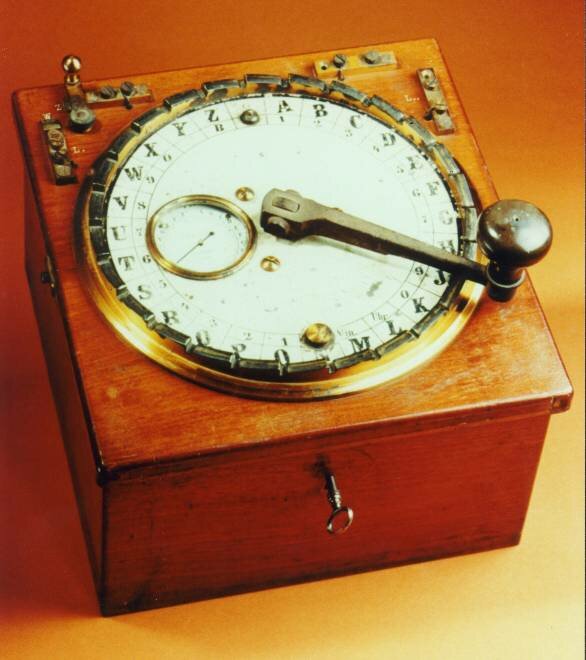
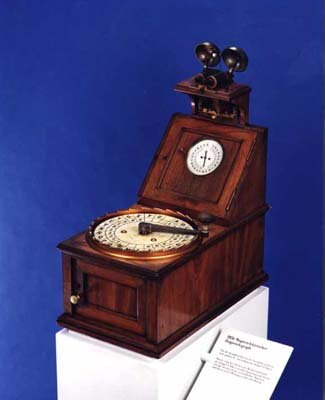
Examples of Dial Telegraph Machines Around the Civil War Period
 |
 |
| Dial or ABC telegraph by Siemens & Halske circa 1850 |
electric dial telegraph (1856) in the collection of Siemens in Munich, Germany |
 |
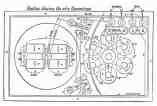 |
| Wheatstone ABC/dial telegraph patented 1858 | Beardslee dial telegraph December 27,1859 (26557) patent |
|
|
| Beardslee dial telegraph December 27, 1859 (26558) patent | Beardslee dial telegraph August 4, 1863 (39376) patent |
The Beardslee Telegraph machine (1862) was part of Maj. Myer's dream of Signal Train. It's advantages were that it would operate without batteries and could be operated by men without knowledge of morse code. Thus, it was a progressive invention that changed the world, order essay online to review not only the materials on our site, but also theories and analysis. Unfortunately for Maj. Myer, the Beardslee in operation wasn't as promising (discussion) as many had hoped. The machine required lots of maintenance, didn't send signals as far a distance as battery powered devices, and the device itself fought acceptance from the professional telegraphic community. It also was one of the controversies surrounding Maj. Myer's conflict with Secretary of War Stanton and his command transfer.
The Beardslee operates using magnetos. The magnetos generate the needed power to send electricity over the telegraph wire. In theory, the operator need only to move the lever to a point on the dial representing the "letter" he wishes to send as part of his message. On the receiving end, the dial will move to the corresponding position on the dial. Thus, the signal is sent exactly as it was meant to be sent and, theoretically, without error. The operator need only copy down the characters he sees "dialed".
In practice, however, the operators had to do more than just turn the lever to the correct character on the dial. There was a whole set of steps and procedures for the operation of the machine. Additionally there was a set of procedures which had to be followed by all operators of a Beardslee along a given telegraph circuit in order for messages to be sent. To many operators of the Beardslee, it was complicated and not as easy to learn as promised. Among many, it was considered an "expensive failure". Repeatedly, it was demonstrated that trained operators using a conventional telegraph system could send messages faster than most, if not all, operators using a Beardslee machine. This is due, in part, to the fact that the Beardslee was never allowed to mature. Operators never gained a similar familiarity with its operation as did the conventional telegraph operators with their telegraph equipment.
In late 1863 (through 1864) when the Signal Telegraph was taken from the Signal Corps and turned over to the civilian USMT. All of the Beardslee machines were removed from service. However, the poles, insulated wire, wire reels and wire laying methods were adopted by the USMT for the duration of the war.
It is important to note that the Beardslee machine was only one of several different "types" of dial telegraph machines or "magneto-electric telegraph machines" as they were sometimes called. At the bottom left are some examples of some other dial telegraphs created around the period of the Civil War. Dial telegraph machines were not new or unique to the Civil War period.
In 1847, Werner Siemens was developing the "automatic dial telegraph". In 1856, the Bavarian Railway was using a dial telegraph system quite successfully.{John Goldfinch of Great Britain adds: "The difference between the ABC and the Beardslee is that the magneto is turning all the time and buttons at the letters stop the sending mechanism to interrupt the pulses sent. Hence the pulses are of more even magnitude but the mechanism is complicated and delicate and not for use in the field in my opinion".} Because of the technological success elsewhere in the world, Maj. Myer's dream doesn't seem so "far out". However, the Beardslee machine didn't have the same maturity as those created by Siemens and it was nearly doomed for failure almost from the start.
Here is what Major Myer (then Brevit Brigader General) said about the "Beardslee Instrument":
From Page 369--Manual of Signals
There were advantages to attaching to this instrument, that it was portable and compact, could be set a work anywhere, required no batteries, acids, or fluids; and, what was thought of importance in the early days of the late war, and while the corps was a temporary organization, it could be worked by soldiers without skill as operators. The defects were, that messages could not be sent as rapidly or as far as by some other instruments. Nor could several instruments work easily upon a single circuit. For some uses on the field of battle, or under fire, where the attention of the reader is disturbed, it is, perhaps, as good an instrument as has been devised. With a permanent corps, or at secure stations it gives place to some of the forms of signal or of sound instruments."
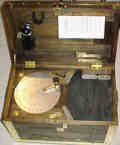
Link to Beardslee construction photos
Beardslee Manual in Word Format
Beardslee Manual in PDF Format

Main Page